
How to Start a Coffee Shop in Saudi Arabia: The 7-Stage Roadmap
Opening a coffee shop in Riyadh, Jeddah, or Khobar is a dream for many, and for good reason. If you’re planning to start a coffee shop in Saudi Arabia, you’re entering a market fueled by a young population, a late-night social culture, and a growing appreciation for specialty beans like Khawlani and Ethiopian Yirgacheffe.
But the reality of opening a cafe here goes far beyond brewing a great V60. It involves navigating Balady technical requirements, understanding Civil Defense safety codes, meeting Saudization (Nitaqat) quotas, and integrating ZATCA-compliant e-invoicing systems.
Whether your vision is a drive-thru container on a high-traffic road or a cozy third-wave lounge in a quiet neighborhood, long-term success depends on getting the operational details right.
This guide breaks the complex journey of opening a cafe in Saudi Arabia into 7 practical, manageable stages. We don’t just tell you what to do—we show you how, using local insights, realistic SAR cost estimates, and direct references to official government requirements.
🚦 Start a Coffee Shop Phase 1: Planning & Feasibility

Before you spend a single Riyal, you need to know if the numbers work.
The “Spanish Latte” economy is real, but so is the competition. In this stage, you must move beyond the dream and look at the hard data. A typical small-to-medium coffee shop in Saudi Arabia requires a startup capital ranging from SAR 180,000 to SAR 500,000+, depending on your location and fit-out quality.
You need to answer three critical questions:
- Who is your customer? (e.g., Morning employees needing speed vs. evening students needing study space).
- What is your menu concept? (Specialty coffee only, or heavy on sweet signature drinks and desserts?).
- What is your break-even point?
In this section, we cover:
- Profitability Analysis: Real margins for coffee shops in KSA (typically 15–25%).
- CAPEX Breakdown: Where your money goes (Rent vs. Equipment vs. Licenses).
- Menu Engineering: Why you need a “Signature Drink” to survive in the Saudi market.
👉 : Read the Full Guide to Planning & Coffee Shop Feasibility
📜 Phase 2: Licensing & Compliance
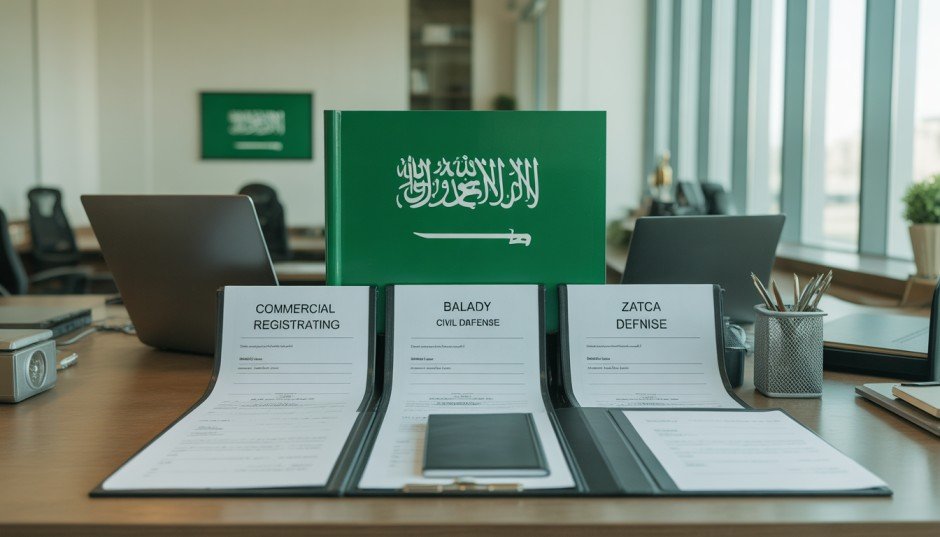
Navigating the Ministry of Commerce, Balady, and ZATCA.
This is often the most intimidating part for new owners. Government procedures in Saudi Arabia have become much faster and more digital, but the sequence matters. If you lease a shop that the Municipality (Balady) rejects later, you lose your money.
The general workflow is:
- Commercial Registration (CR): Issued by the Ministry of Commerce (approx. SAR 1,200/year).
- Municipal License (Rakhsat Balady): Requires a physical inspection of your location.
- Civil Defense Permit: Mandatory for safety (fire extinguishers, smoke detectors).
- ZATCA Registration: For VAT and E-invoicing (Fatoorah).
In this section, we cover:
- The Paperwork Timeline: Step-by-step order to avoid fines.
- ZATCA Phase 2: Understanding QR codes and compliant POS systems (like Foodics or Odoo).
- New Rules: Updates on “Home Delivery” permits and 24-hour operation licenses.
👉 : The Ultimate Guide to Coffee Shop Licensing & Balady Requirements
📍 Phase 3: Location Selection & Leasing
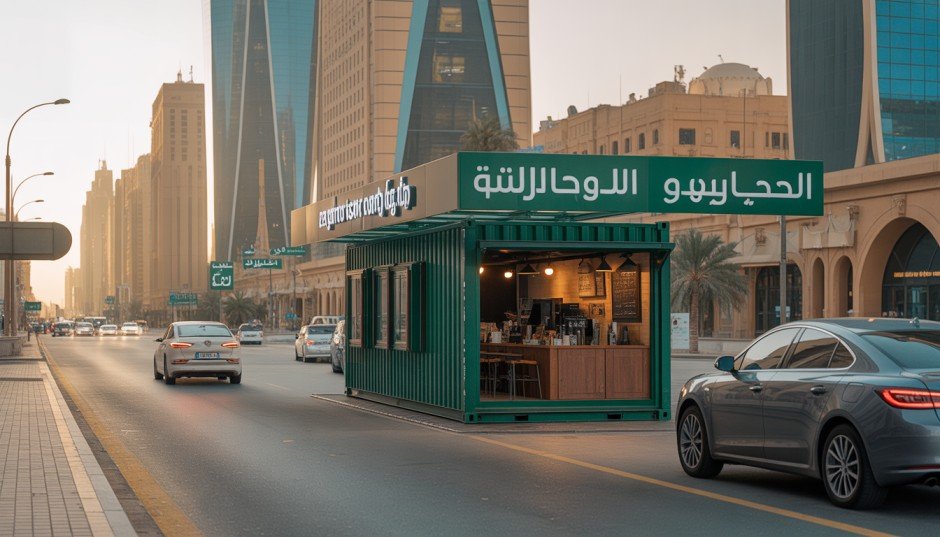
Finding your winning spot in a city designed for cars.
In Saudi Arabia, parking is everything. A cafe with no parking in Riyadh is a cafe with no customers. You also need to understand the Ejar system—the government’s mandatory rental contract platform. Without a registered Ejar contract, you cannot issue your Municipal license.
Rents vary wildly. A drive-thru shell in a prime area like Hittin (Riyadh) or Al-Rawdah (Jeddah) can command premium prices, while a quiet neighborhood spot might offer better margins for a start-up.
In this section, we cover:
- Neighborhood Analysis: Hot zones in Riyadh, Jeddah, and Dammam.
- Leasing Benchmarks: Average rent per square meter for 2025.
- The “Grace Period”: How to negotiate 2-3 months of free rent for your fit-out phase.
👉 : How to Find & Lease the Perfect Cafe Location in KSA
🏗️ Phase 4: Design, MEP & Fit-Out
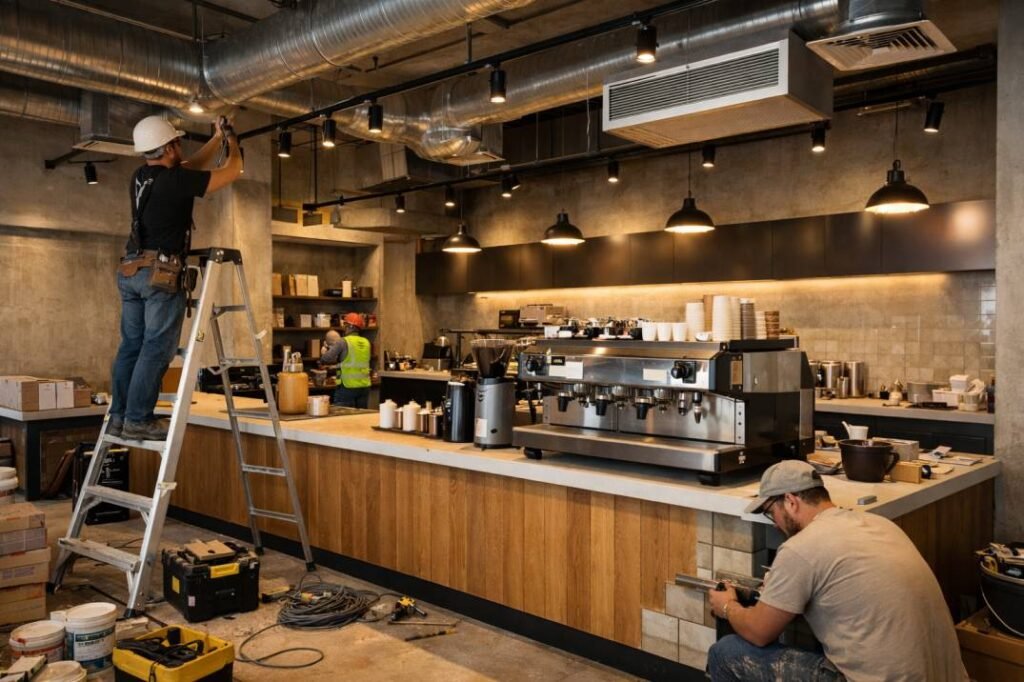
Turning a concrete shell into a destination.
Your design isn’t just about aesthetics; it’s about regulation. Balady has strict codes for cafes, including:
- Glass Frontage: Visibility requirements.
- Signage: Arabic text must be 50% of the signboard size.
- Accessibility: Ramps and bathrooms for People of Determination are mandatory.
Technically, you must plan your MEP (Mechanical, Electrical, Plumbing) carefully. Espresso machines consume huge amounts of power, and Saudi summers require heavy-duty HVAC (AC) systems to keep customers cool.
In this section, we cover:
- Fit-Out Contractor Guide: How to hire a reliable contractor and avoid scams.
- Technical Specs: Electrical loads (kW) and water filtration (Reverse Osmosis) for coffee quality.
- Grease Traps: Why you need one even if you don’t cook heavy food.
👉 : Cafe Design & Fit-Out Guidelines for Saudi Arabia
☕ Phase 5: Equipment & Supply Chain
The engine of your business: Machines and Beans.
You cannot serve a SAR 22 V60 using cheap beans. The Saudi consumer is educated and demanding. You need reliable suppliers for your “Consumables” (cups, syrups, milk) and a sturdy maintenance contract for your espresso machine.
Should you buy a La Marzocco or a Victoria Arduino? Should you import beans or buy from local roasters like Camel Step, Soil, or Elixir?
In this section, we cover:
- Espresso Machine Buyer’s Guide: Top models used in Saudi cafes and their prices.
- Local Roasters List: Wholesale bean suppliers in the Kingdom.
- Supply Chain: Sourcing branded cups, lactose-free milk, and syrups.
👉 : The Complete Equipment & Supplier List for Saudi Cafes
👥 Phase 6: HR, Staffing & Training
Saudization (Nitaqat), Visas, and Barista Skills.
Your coffee is only as good as the hand that pours it. Staffing involves a mix of hiring talented expatriates and meeting Saudization (Nitaqat) quotas. As of 2025, cafes usually fall into the 40-50% Saudization range (depending on size and location), meaning you must hire Saudi nationals for roles like cashiers, managers, or baristas.
You also need to budget for government fees: Iqama renewals, GOSI (Social Insurance), and health insurance.
In this section, we cover:
- Nitaqat Explained: How to calculate your green zone status.
- Hiring Channels: Where to find baristas (Expat and Saudi).
- Salary Benchmarks: What is a fair wage for a Head Barista vs. a Junior?
- Training: Top barista academies in Riyadh and Jeddah.
👉 : HR Guide: Hiring, Visas, and Saudization for Coffee Shops
🚀 Phase 7: Marketing & Daily Operations

From Soft Opening to Daily Profit.
Saudi Arabia has one of the highest social media penetration rates in the world. If your cafe isn’t on Google Maps with high ratings, and if you aren’t visible on TikTok or Snapchat, you don’t exist.
But marketing brings them in; operations bring them back. You need strict Standard Operating Procedures (SOPs) for opening and closing the shop, managing inventory, and ensuring every cup tastes the same.
In this section, we cover:
- Launch Strategy: How to execute a “Soft Opening” to test your workflow.
- Social Media: Why Snapchat and TikTok beat Instagram for Saudi cafes.
- Delivery Apps: Managing HungerStation and Jahez commissions (approx. 20-25%).
- Daily Checklists: Managing waste, cleaning, and cash handling.
👉 : Marketing & Operations Guide for Saudi Coffee Shops
📥 Free Downloadable Checklists
Get organized with our operational sheets.
- [Download] The “Before You Spend” Feasibility Checklist
- [Download] Balady & Municipality Inspection Readiness Sheet
- [Download] Daily Opening & Closing Shift Checklist
- [Download] Barista Hiring & Interview Questions
Ready to Start?
Opening a coffee shop is a journey. Start by validating your idea in Phase 1: Planning & Feasibility, or if you already have a location, jump straight to Phase 2: Licensing.